
Blog
qdTest: test and programming adapters for small series and varied production
Quality assurance in electronics manufacturing usually costs a great deal of infrastructure. The qdTest family makes do with considerably less.
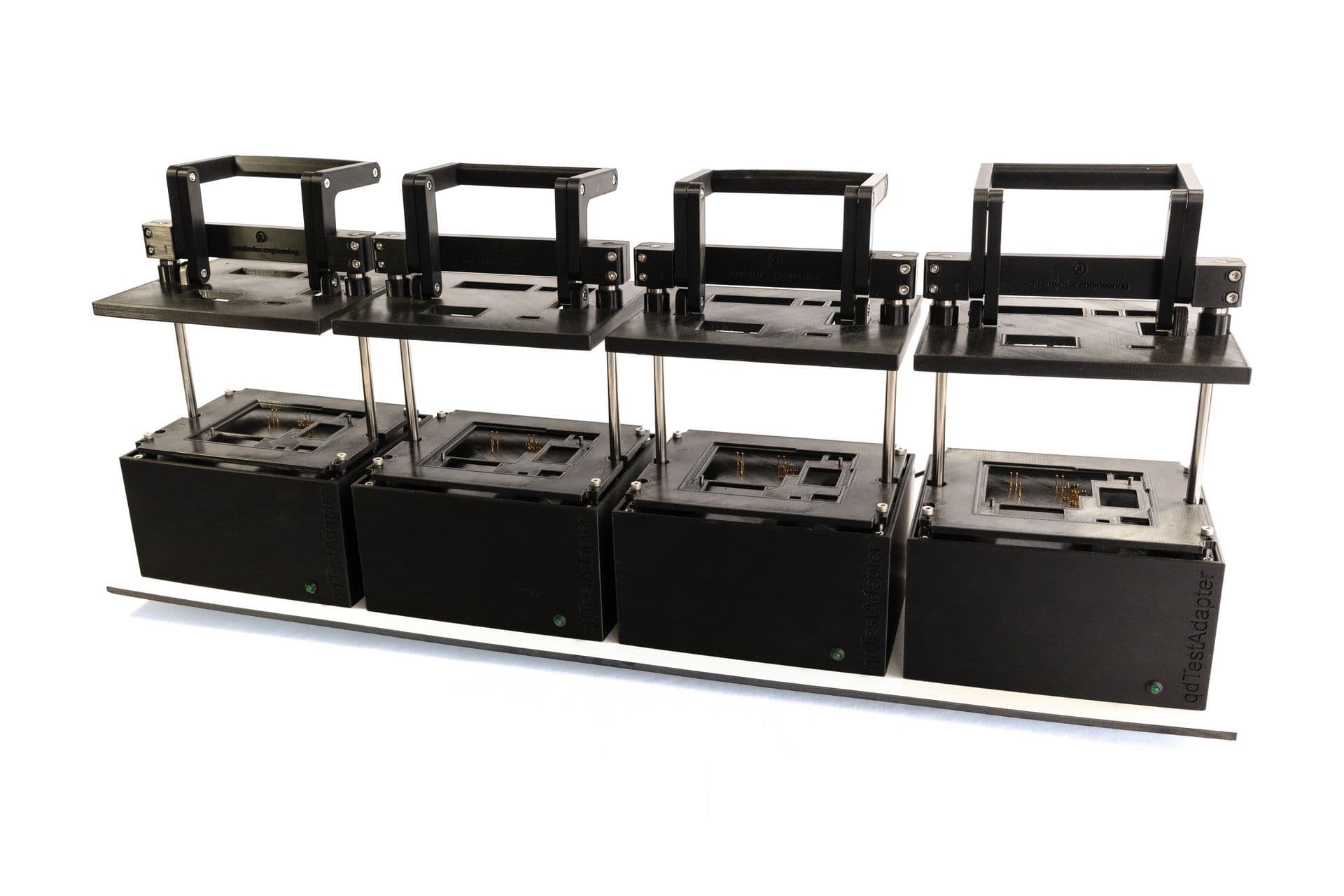
Testing without limits: checking circuit boards with qdTest, flexibly, economically and independently.
For manufacturers of electronic devices in small and medium volumes, quality assurance usually comes with high costs and a complex infrastructure. The modular qdTest system family from querdenker engineering now offers a compact and economical stand-alone answer that does without external infrastructure while still covering a wide range of functions. With individually 3D-printed fixtures and standardised electronics modules, test and programming tasks can be carried out flexibly, from simply flashing firmware to complex functional tests with integrated measurement. The system suits varied production in particular, in medical technology and other regulated sectors.
Quality assurance in small series
In electronics manufacturing, programming and functional testing of assemblies are indispensable parts of quality assurance. Once boards are populated, the assemblies have to be checked for correct function and the firmware or configuration loaded. Externally manufactured components have to pass an incoming inspection to make sure they are free of faults.
The test systems available on the market, however, are as a rule designed for large volumes. They call for an elaborate infrastructure with extensive laboratory hardware, additional measurement and programming equipment, and workplaces staffed by qualified specialists.
For device manufacturers with small and medium series or varied production, investing in such test facilities barely adds up economically. Outsourcing test work to external providers, on the other hand, means a loss of flexibility, of control over quality and of know-how, which from a strategic point of view is its own problem.
qdTest: the modular test and programming adapter system
The qdTest family was developed specifically for small and medium volumes. The aim was a modular system that is easy to configure and convincing both economically and functionally, closing a gap in the market.
So that anyone interested can check the economics quickly, anonymously and without going into detail, an online price calculator is available to work out the rough cost.
A key feature of qdTest is its compact construction, individually adapted to the design of the board under test. The system combines mechanics, measurement and software in a single device. As a genuine stand-alone solution it needs no external PC. It can be operated either through integrated buttons or through a connected barcode scanner and monitor, which makes it easy to fit into existing production processes. Test results can be stored on a USB stick or sent directly to the ERP system through a REST API. The test configuration and the microcontroller firmware to be flashed are held on the USB stick and can be managed through cloud access where required.
The qdTest adapters are 3D printed individually and adapted to each client's requirements. Standardised electronics modules make flexible configuration possible. The range runs from simple programming adapters to complex functional test set-ups with current and voltage measurement, switching relays and multi-channel supply.
Compared with conventional test systems, the investment is considerably lower. Savings in the five- to six-figure range are possible. Because the qdTest system is compact and works on its own, no elaborate equipment infrastructure is needed. Software-driven automation makes test processes reproducible and efficient. Remote maintenance is possible through an optional cloud connection. The device manufacturer stays independent and, when using the cloud, retains authority over all test data.
Electronics boards combined for board-specific tests
The technical platform of qdTest is built on electronics of our own design, consisting of a Raspberry Pi 5 as the system-on-module, integrated voltage sources and various communication buses. Depending on what has to be tested, different expansion modules can be used, for example for relay control, voltage and current measurement, or programmable power supplies.
Among the available modules is a relay board with eight channels that switches voltages up to 30 volts and currents up to 1 ampere. A voltage measurement board measures on 16 channels with an accuracy of ±0.2 %. A current measurement board records currents on eight channels with an accuracy of ±0.3 %. A two-quadrant power supply provides or absorbs voltages from 2 to 20 volts at ±5 amperes, with an accuracy of ±0.15 %.
The adapters take boards up to 250 x 170 mm and have room for up to ten electronics modules. Housings are available in sizes S, M and L, in variants with a lever or with a cable outlet.
The online configurator
The qdTest configurator from querdenker engineering GmbH is an online tool that lets developers configure the test system themselves. Both the mechanical specification and every electronic component can be chosen to suit the task.
The configurator leads the user through the whole process. Mechanical, electronic and test-specific parameters can be defined precisely. On that basis, a concrete quotation can be requested and a transparent price worked out.
For the mechanical configuration there are four housing types to choose from, which set the construction and the size of the test system. It can also be specified whether the system should have operating controls and automatic close detection.
Two buttons allow the system to be operated without a connected mouse or keyboard. That makes sense where manual input is needed during the test sequence, or where a compact set-up matters. Integrated LEDs signal the test status, so that simple programming or test tasks can be carried out without a monitor. Automatic close detection registers when the adapter is closed and starts the test or programming process on its own, with no further manual step.
The configurator also covers how many boards are tested and exactly where they sit in the system. One particularly practical feature: a test point report from the CAD system can be imported directly, and the test points of the board are shown. Test points can also be added by hand. The final layout can be exported as a DXF file, for verification and for integration into your own CAD system.
In the electronics part of the configurator, the complete power supply, the communication interfaces, suitable microcontroller flashers and the relay, voltage and current measurement functions can all be specified, so that the electronics modules match the test task.
Once the mechanical and electronic configuration is complete, a full summary is produced. It allows a final check of every chosen component before the price is calculated and the enquiry sent.
A further function of the configurator is that test sequences can be defined and managed: in what order and under which conditions the individual test steps are later carried out.
More autonomy and price transparency in board testing
What sets qdTest apart is that quality assurance and the development department can configure the test and programming system themselves. The online configurator does away with the time-consuming process of writing specifications. Together with it, the qdTest system lets people define their requirements, choose the electronic components they want, organise the test cases and work out a transparent price. The team at querdenker engineering is available for individual advice alongside. From the second system onwards, staggered prices apply.
qdTest keeps electronics test systems simple and, through its price, makes them viable at small and medium volumes.