
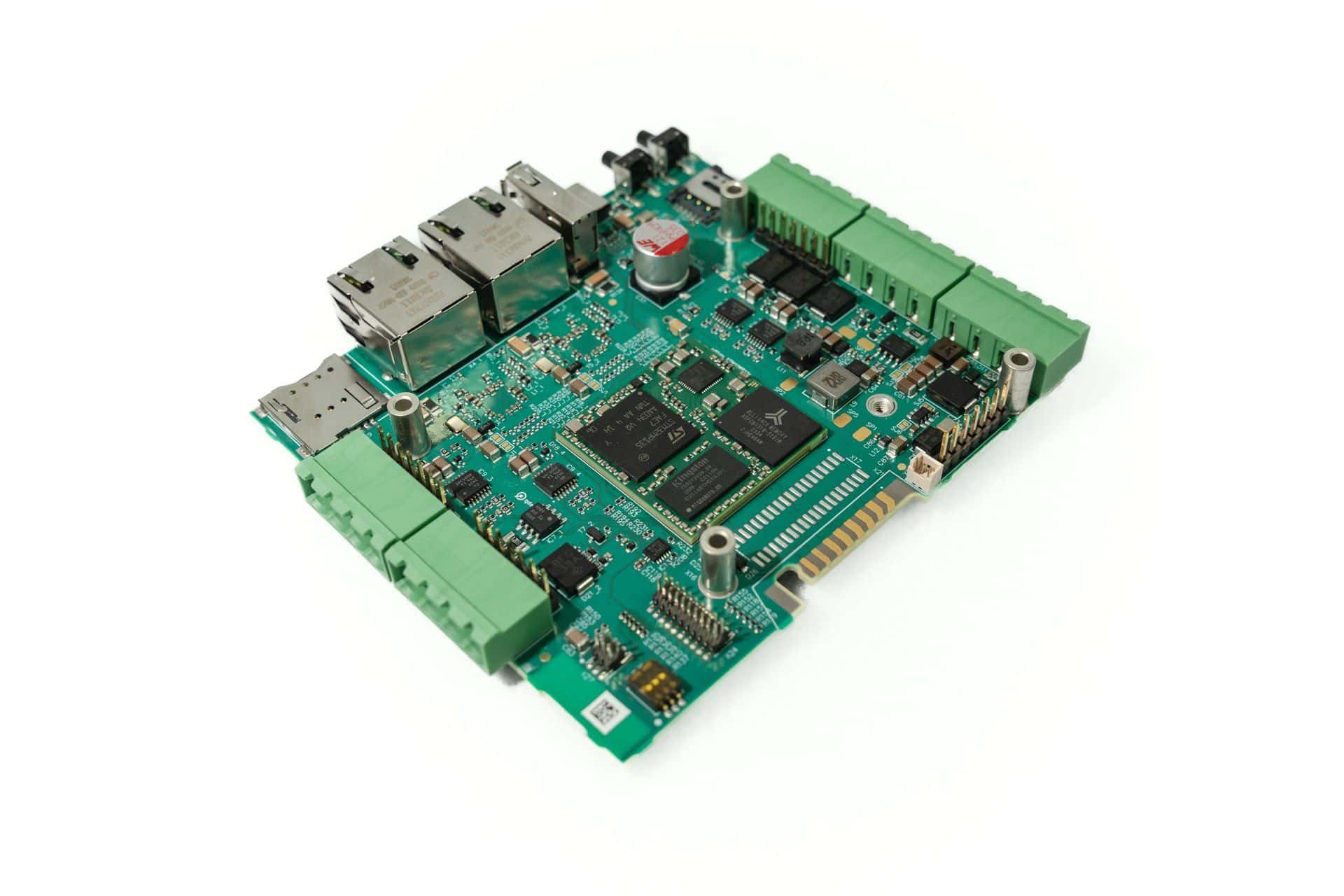
Open Linux platform · Made in Germany
qdGate: edge computing and IoT gateway
The open Linux gateway processes real-time data where it is created and connects the machine to the cloud, ERP and AI, where the data adds value. Together with qdCoreX and qdCloud, qdGate is a complete IoT framework.
- Open Linux with source code: qdCoreX on Buildroot with a mainline LTS kernel
- Secure boot in the SoC, signed updates with fallback to the previous version
- Ten years' availability, ten years of Linux maintenance
The device
A strong foundation
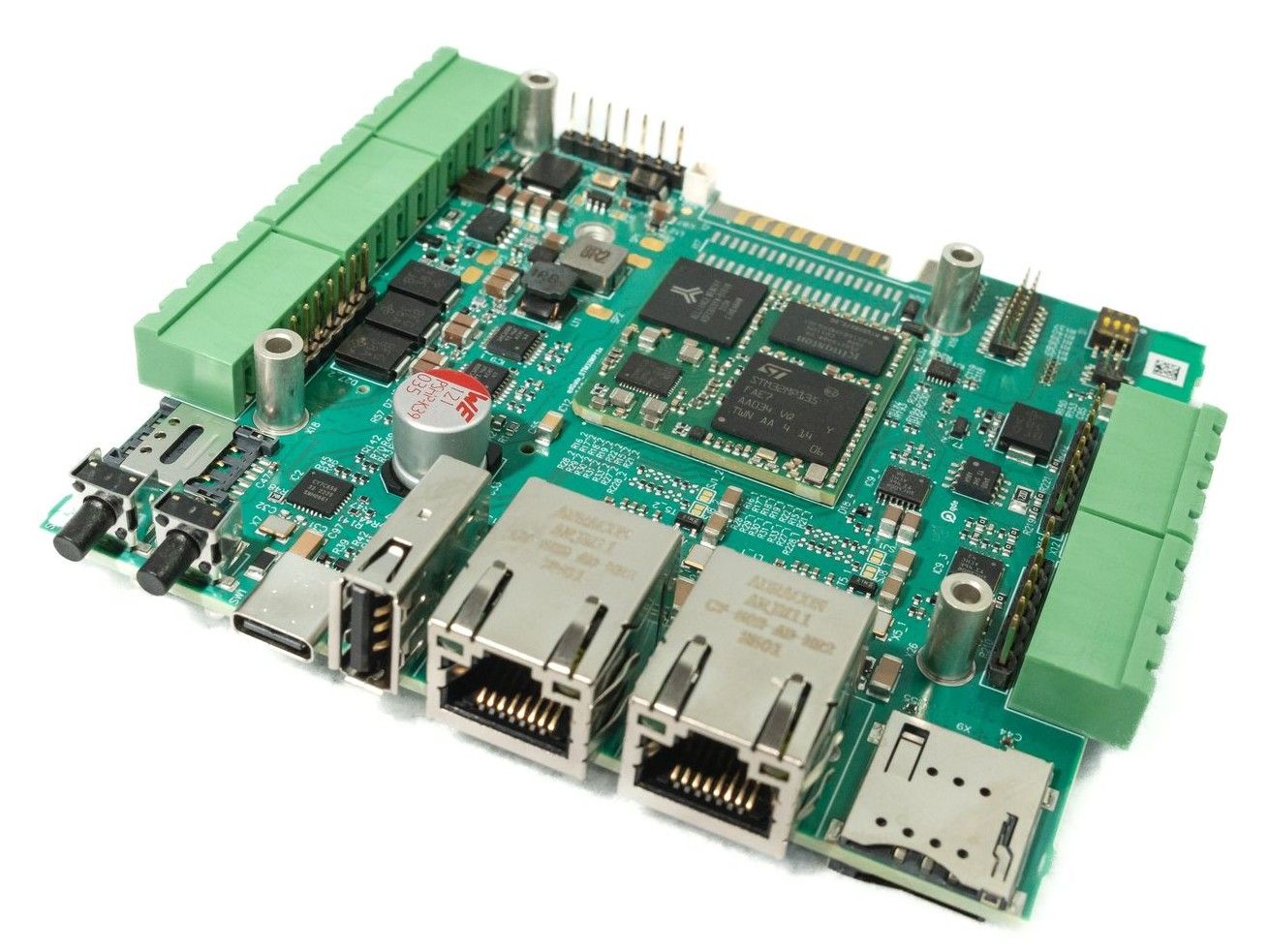
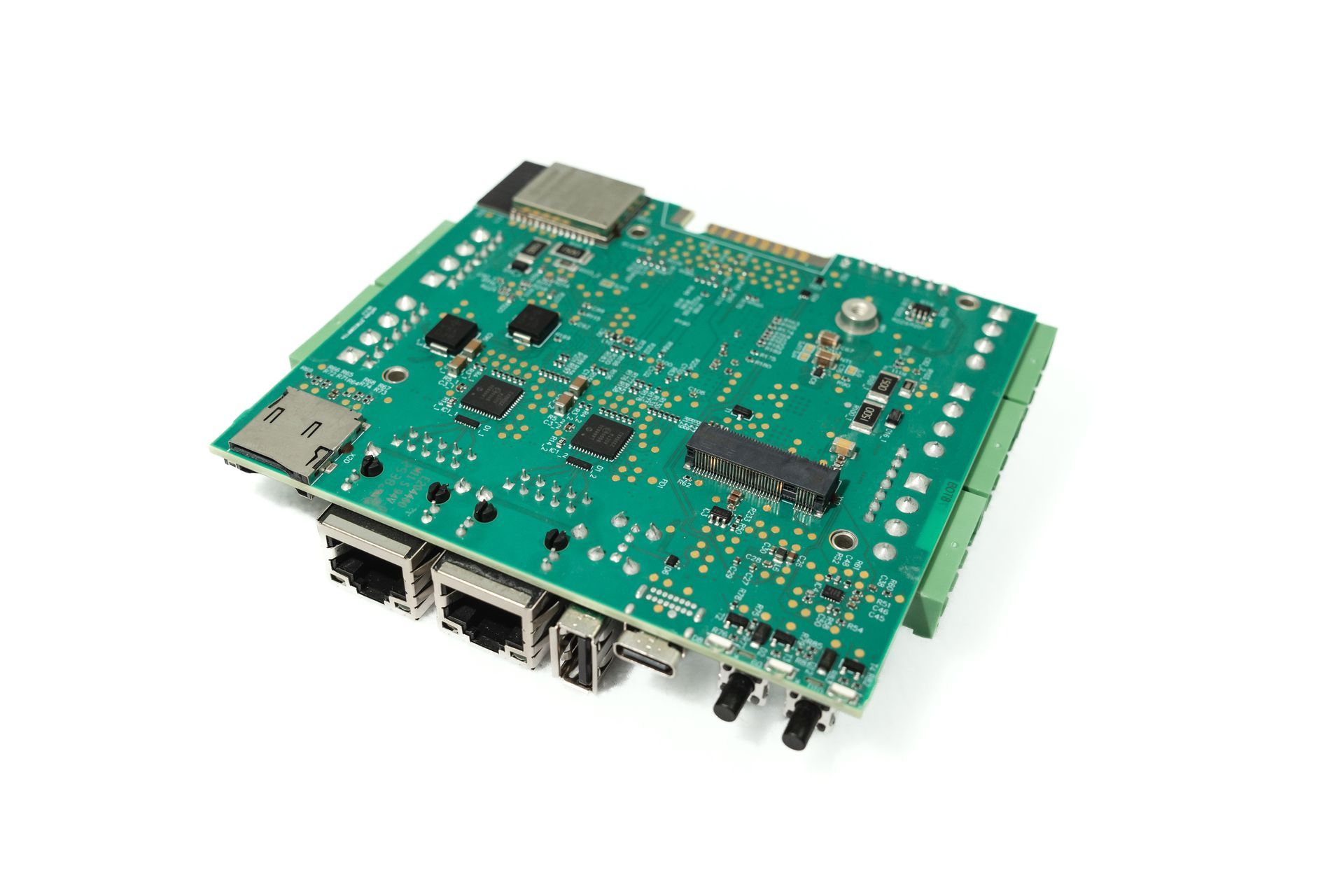
2 × RS-485
Galvanically isolated, for Modbus to the controller, meter or drive.
4 × digital inputs and outputs
Switch up to 1 A straight from the 24 V supply or read a floating contact.
2 × analogue current and voltage inputs
0 to 10 V or 4 to 20 mA at 12 bit. The measuring mode can be switched by software.
2 × Gigabit Ethernet
Keep the plant network and the office network physically separate.
Wireless and cellular
Wi-Fi 6 and Bluetooth 5 on board, LTE as an M.2 modem with two SIM slots.
Processor and keys
STM32MP13x with Arm Cortex-A7, secure boot and TrustZone.
Plenty of room for your custom requirements
Expansion bus with CAN, QSPI, UART and I²C for your adapter board.
Development
Technical foundation
qdCoreX as the foundation
qdCoreX is built on Buildroot with a mainline LTS kernel. Buildroot is straightforward and developer-friendly: a configuration menu like the kernel's, a build from a single directory and an image that contains only what your device needs.
Updates with RAUC
Updates run with RAUC on the A/B principle: the signed bundle is written to the inactive partition and booted from there. If the boot fails, the device automatically boots the previous version again. Updates are distributed via qdCloud or your own channel.
Standard Linux interfaces
The hardware is described in the device tree and accessible from your application through standard interfaces: digital inputs and outputs with libgpiod, analogue inputs via Linux IIO, I²C and SPI via the usual device files.
Linux maintenance
Every two years the next mainline LTS kernel, plus vulnerability monitoring over ten years. For the Cyber Resilience Act: SBOM, assessment, update. The contract defines the scope.
Customisation
How qdGate becomes your product
In component population, inputs and outputs, housing and configuration, qdGate adapts to your needs, giving you the best cost-benefit ratio from as few as 100 units.
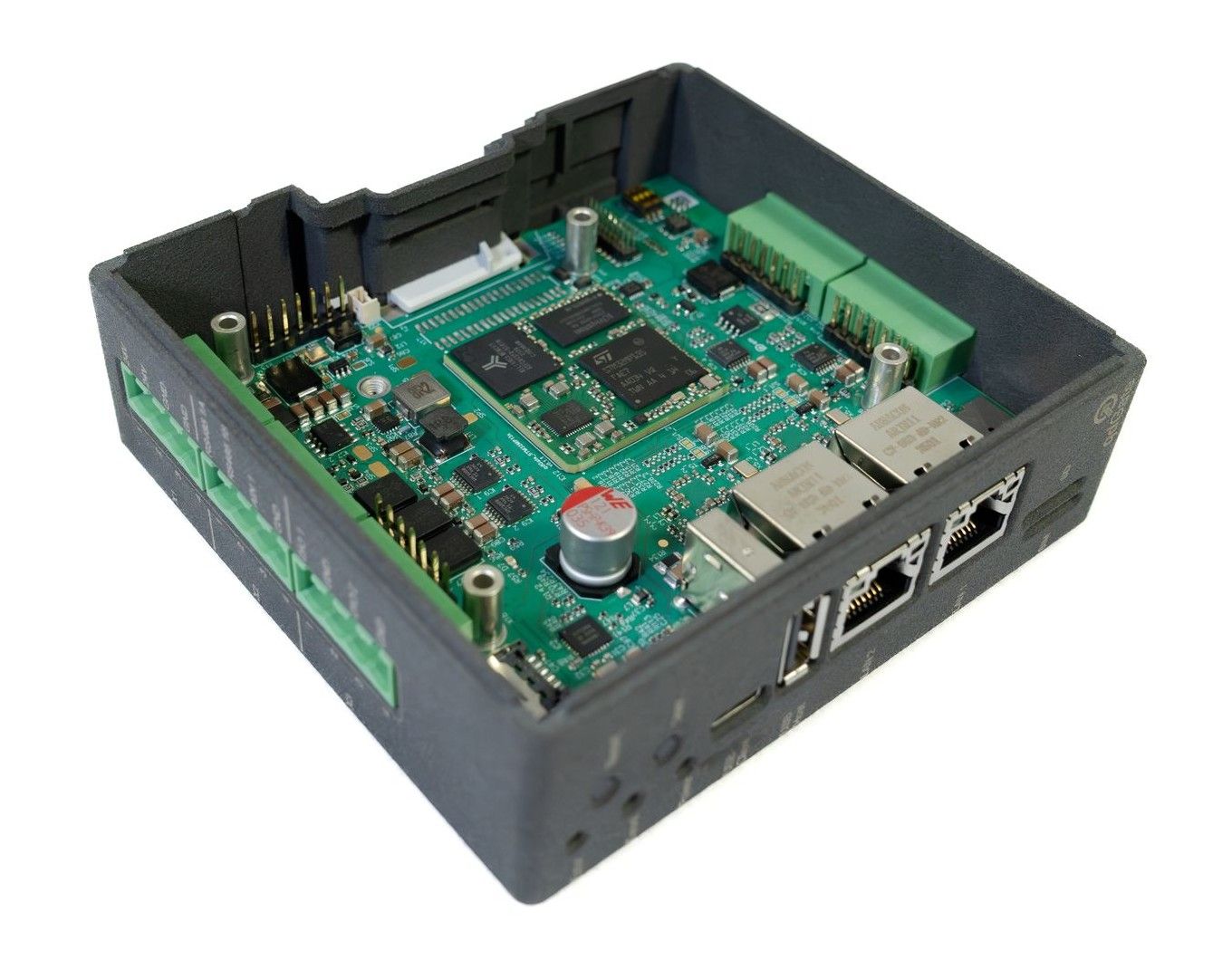
Component population to suit your needs
We define RAM, eMMC, RTC backup, antennas, LTE modem and every other component with you in the bill of materials, so that only what adds value for you is fitted.
Temperature range for your site
Standard 0 to 50 °C and extended variant −20 to 70 °C.
Plenty of room for expansion
Another fieldbus, a sensor front end or a radio module, for LoRa for example, can easily be added as a piggyback board. Our housing and interface concept leaves plenty of room for expansion.
Housing, labelling and your logo
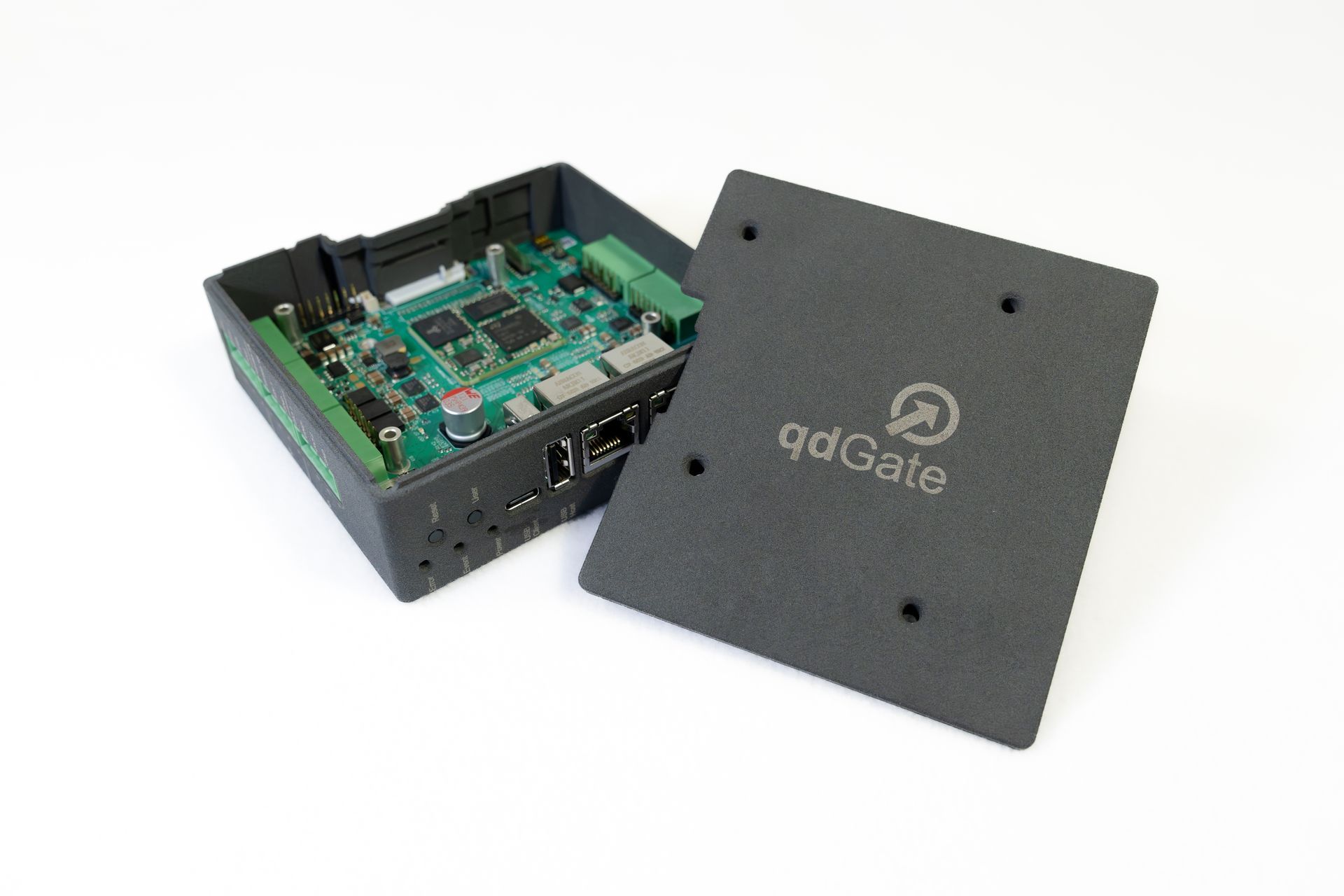
Cut-outs for your connectors, labelling to match your terminal assignment, your logo on the front and/or on the side.
Configured for you at the factory
We install your image, test the expansion boards, install device certificates, assign serial numbers and pack to your specification.
Deeper customisation
qdGate can also serve as the basis for your own custom solution in a development or adaptation project. We advise you on this and find the most economical fit for you. If your device needs a graphics unit or more computing power, qdSBC is the next level of the platform.
Standard where it can be. Pins where it counts.
Make an enquiryqdGate
AvailableEdge computing and IoT gateway
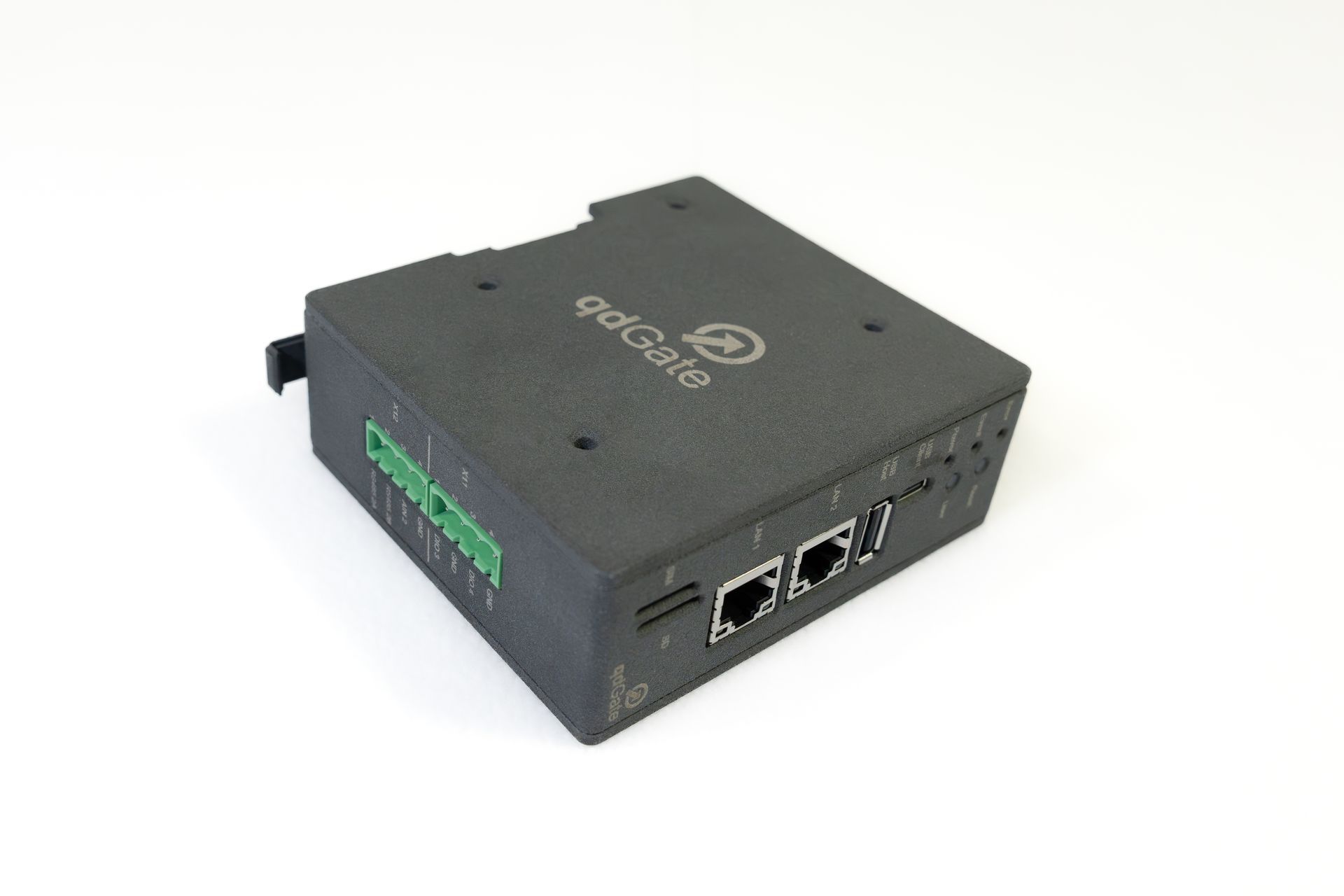
qdGate is a product platform for industrial applications: fieldbus, network and mobile connectivity in a control cabinet housing, as a base for your own device.
| Processor | STM32MP13x, Arm Cortex-A7, 650 MHz to 1 GHz |
|---|---|
| Memory | 512 MB DDR3 (options 128 MB to 1 GB), 4 GB eMMC (options 8 and 16 GB), SD card slot accessible from outside |
| Network | 2 × Gigabit Ethernet, Wi-Fi 6 (2.4 GHz), Bluetooth 5, M.2 socket for an LTE modem with nano and micro SIM, switchable in software |
| Fieldbus | 2 × RS-485, galvanically isolated, up to 9 Mbit/s, 120 Ω termination |
| I/O | 4 × digital I/O (output up to approx. 1 A per channel from the supply), 2 × analogue input 0–10 V or 4–20 mA, 12 bit |
| USB | 1 × USB-A host (up to 700 mA), 1 × USB-C device for programming and recovery |
| Expansion | Internal expansion bus with 2 × CAN, QSPI, UART, 2 × I²C; free pins in the customer-specific design section |
| Security | Secure Boot, Arm TrustZone, OP-TEE; in the SoC: AES and TDES, AES with side-channel protection (SAES), public-key accelerator (PKA), hash, random number generator (TRNG), OTP fuses, tamper detection; updates only with a signed RAUC bundle |
| Power | 24 V DC (21 to 28 V), typically 150 mA |
| Monitoring and clock | Hardware watchdog in the SoC; RTC backed for approx. 10 years by a lithium cell, alternatively a gold cap |
| Enclosure | 110 × 115 × 30 mm, 180 g, polyamide (UL 94 V0), IP20, DIN rail mount |
| Operating temperature | 0 to 50 °C; extended variant −20 to 70 °C; storage −40 to 85 °C |
| Operating system | qdCoreX: Buildroot Linux with a mainline LTS kernel, updates with RAUC |
| Availability | 10 years' availability and maintenance |
Transparency from the start
Does qdGate run without qdCloud?
Yes. Updates then come through your own channel or on a USB stick, and operating data goes to your system. qdCloud takes fleet management and rollout off your hands if you want it to.
View qdCloudCan we build and change the Linux ourselves?
Yes. You receive qdCoreX as a Buildroot external with source code and keep your changes in a layer of your own. We change the bootloader, partitioning and signature chain together with you, so that the update path stays intact.
What if the interfaces are not enough?
First we look together at the options offered by component population and free pins, then at whether an adapter board is the answer. In extreme cases, further devices can be connected via a DIN-rail bus.
Is there a development kit?
The gateway is developer-friendly enough to be used for development itself. The advantage: in series production, everything behaves exactly the same.
Does qdGate fit your idea?
Tell us what the device has to do, and we will work out the best solution with you.