
MedTech
Li-ion battery with charge indicator for mobile medical devices
Systems engineering, electronics and firmware for a rechargeable battery insert in several sizes, developed to IEC 60601-1 and IEC 62133-2 within the scope of the MDR, through to transfer into production.
The task
Mobile medical devices are still often powered by primary cells. For the user that means changing batteries; for the manufacturer it means that a rechargeable replacement has to fit the same devices, with the same contact surfaces, the same label and no change to the device.
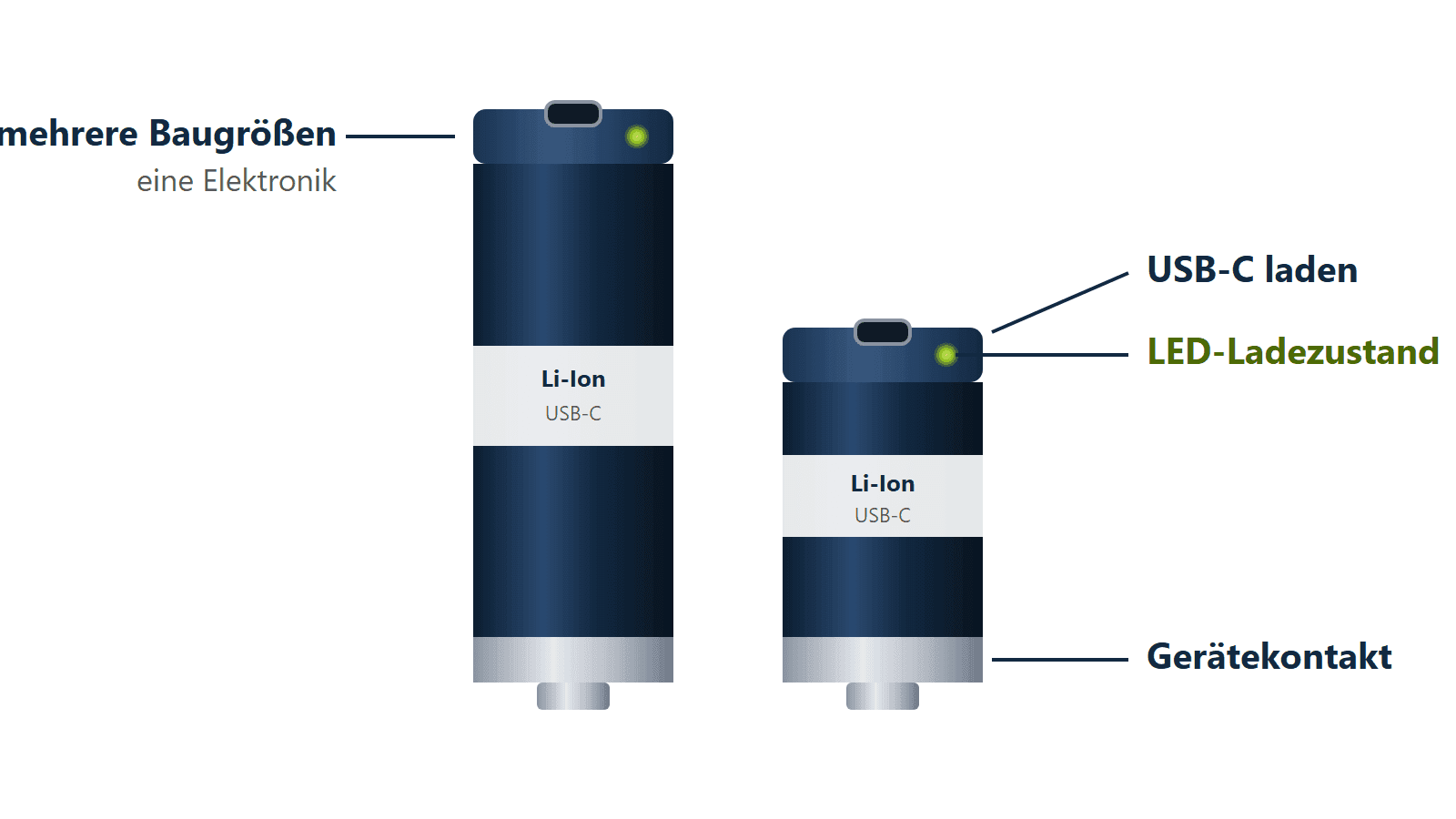
The client wanted this battery as a product of its own: several sizes for its device family, charged through a USB-C socket directly on the battery, with a charge indicator visible from outside and a standby time that allows months of storage. Development followed the requirements of IEC 60601-1 and of IEC 62133-2 for cells and batteries, within the scope of the MDR and the battery regulation. And inside the device, the battery must not do anything the device does not expect.
The solution
The electronics sit between cell and contact surfaces and decide what the device gets to see. During charging the output is disconnected, so the device cannot be operated from the charger. For an impermissible voltage source at the USB socket, a short circuit at the contacts and an overcharge of the cell, protection functions are provided that shut down in the event of a fault. A fuel gauge with a profile measured for this cell provides the state of charge, which an RGB LED shows through a light guide.
All sizes use the same circuit board and the same firmware; the variant is a configuration. The firmware is built on semf, our software architecture, with a state machine for the battery state. For standby, the controller goes into deep sleep and wakes only to check the cell.
The system design was validated on functional samples before the redesign; the firmware was revised after the client's tests, and a discontinued controller replaced with an available one. For the transfer into production, assembly sequence and documents are laid out so that all sizes are built from the same parts.
The results are the system requirements, the electronics with production documents, the firmware and the documents for production.