
IIoT & Energy
An IoT gateway for energy assets that replaces the control cabinet
A custom gateway with two processors that physically separates the plant network from the control centre. We delivered hardware, embedded Linux, firmware, services and end-of-line testing.
The task
Whoever connects generators, storage and consumers to a control centre needs a device at every site that collects readings, passes on setpoints and secures the link to the outside. At the client, a whole control cabinet with router and controller used to do that, too expensive to deploy by the thousand.
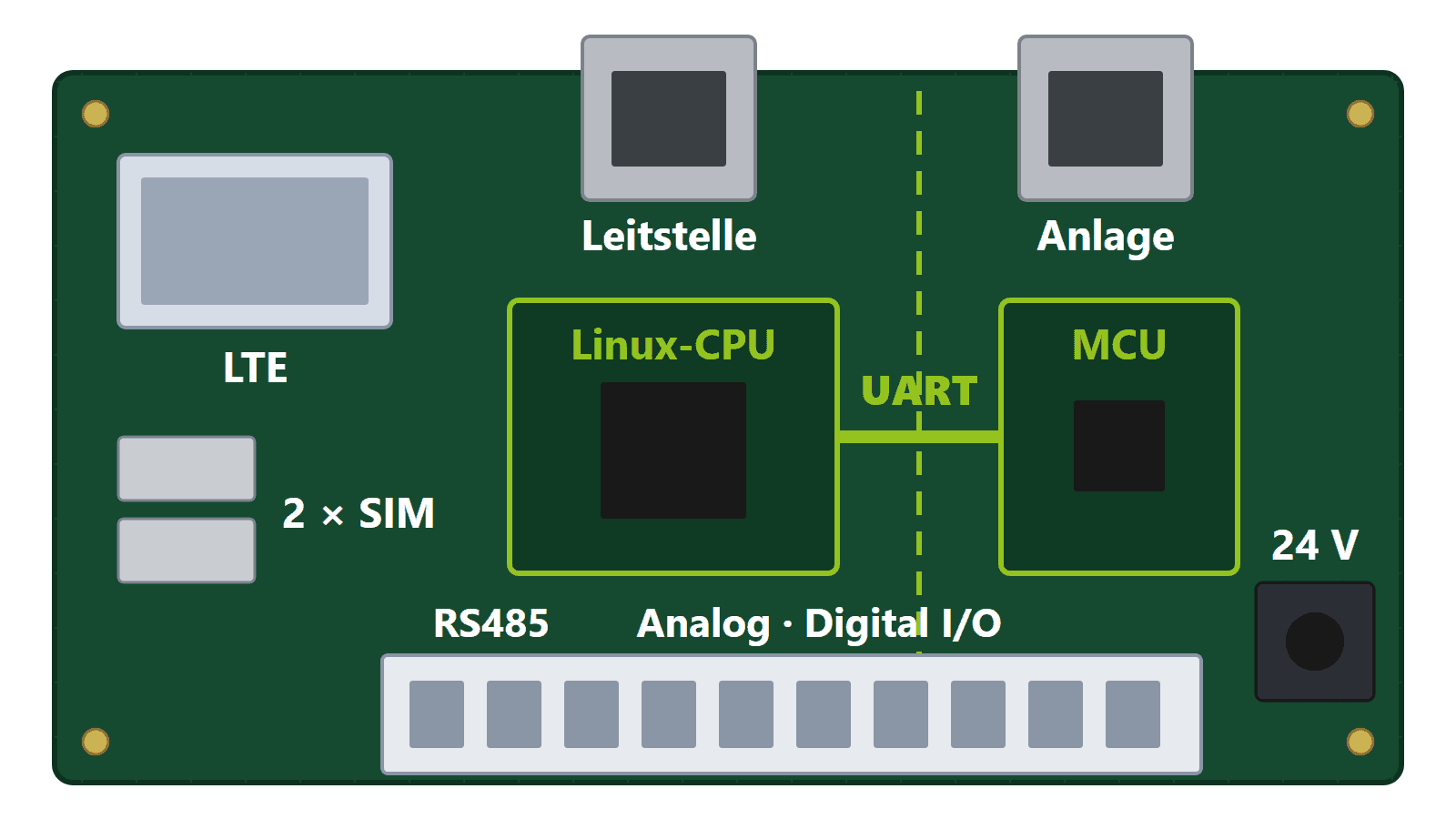
The task was to bring the function of that cabinet into a DIN-rail device: Modbus over RS485 and Ethernet, analogue and digital inputs and outputs, LTE with two SIM cards, Wi-Fi, an operating range from -20 to +85 °C. And one condition from the rules for connecting energy assets: the plant network and the link to the control centre must not share a network path.
The solution
The gateway has two processors. The Ethernet port to the plant ends at a microcontroller that does nothing but take Modbus payloads out of the packets and hand them over a serial line to the Linux main processor. Between plant network and cloud link there is no path an IP packet can take, and the proof of that is in the schematic rather than in a firewall rule.
The main processor runs its own embedded Linux. The link to the control centre is a VPN whose certificates are generated in production. A new certificate replaces the old one only once a connection has been established with it; a firmware update lands in a second slot and becomes permanent only if the device reaches the control centre afterwards, otherwise the previous version boots. The configuration web server opens only after a button press and only briefly, and the control centre can request a hash of the program memory at any time.
We delivered the concept, the main, front-panel and expansion boards, the Linux system, the second processor's firmware on semf, the services for device management, supervision and tunnelling, and the verification up to EMC qualification. For series production a test station on qdTest contacts, measures, registers and provisions every device with its certificates. The client builds its plant logic on top and places the device on the market.