
IIoT & Energy
A wireless push-button in the charging plug that opens the vehicle's charge port
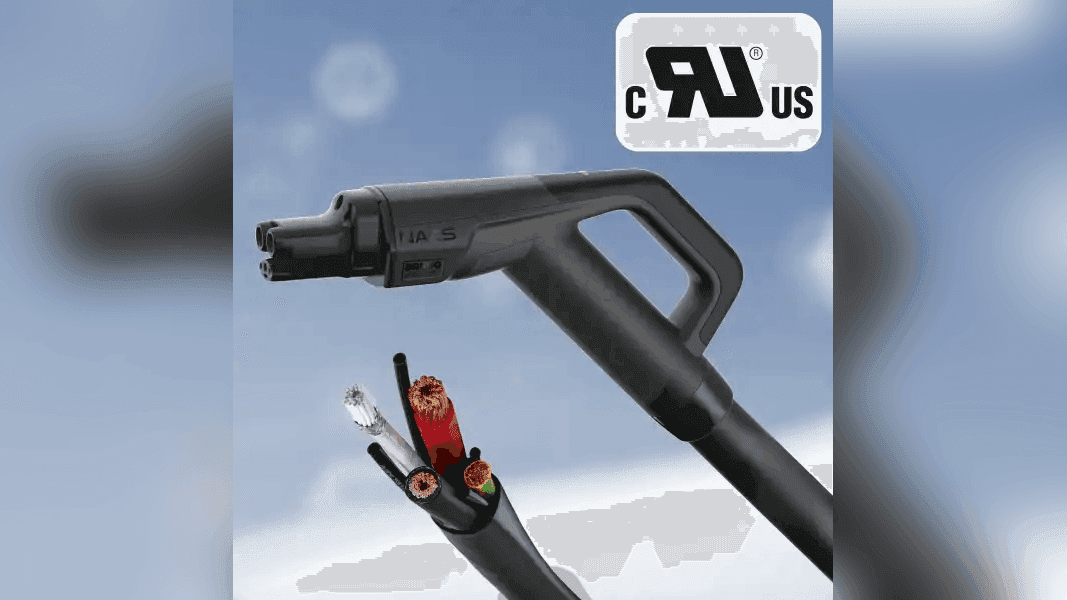
For Brugg eConnect we developed the electronics of a charging plug for electric vehicles, from concept through hardware and firmware to UL approval and series production, in cooperation with Busse Design und Engineering.
The task
When charging an electric vehicle, you open the charge port door first and then reach for the plug. One vehicle manufacturer changed that: a button on the plug opens the door by radio, and your hand stays on the cable. For the plug maker this means that a part which used to be purely mechanical and electrical now contains radio electronics.
Brugg eConnect wanted this function in its plugs to the North American standard. The electronics had to fit the contour of the plug grip, transmit without dropouts in the rough environment of a charging cable and be UL approved for the North American market. The first generation had solved the button with a magnetic switch; the new one was to be a real button with feedback.
The solution
The electronics are a rigid-flex circuit board of two rigid parts that follow the grip: button and LED on one, the radio transmitter with its antenna on the other, the bendable link in between. The antenna is part of the board itself and was tuned to the geometry of the plug, because a grip of plastic and metal shapes the radiation differently than a lab breadboard.
The transmitter IC carries one-time programmable memory. During development the firmware therefore runs only in the chip's RAM, and only the released version is written into the device as a burn image. A test adapter on qdTest contacts every board, measures the current draw, checks the function and programs the transmitter only after the test has passed, in one pass; no device is burned with an unverified version.
Component selection followed the UL requirements for the target market from the start, and radio testing ran in an accredited laboratory. The housing and the ergonomics of the grip were developed at Busse Design und Engineering, the electronics and their testing with us; both were aligned in iterations until layout and grip contour matched.
The plug is UL approved and in series production. What was delivered: feasibility, hardware with antenna design, firmware, test adapter and test sequence, the approval documents and support through UL approval into production.