
Measurement & Laboratory Technology
The electronics of a measuring device for hazardous areas, split across ten circuit boards
Hardware development for the new device generation of a process measuring device that operates in explosive atmospheres. Seven types of protection in one device, an extensive specification, and a development process that plans for review by the client and the certification body from the start.
The task
A measuring device for hazardous areas places demands on its electronics that go far beyond the measuring function. Every supply, every external interface and every sensor connection must be designed so that it cannot become a source of ignition even under fault conditions, and the design must be demonstrable to the certification body.
The client wanted to renew the electronics of its measuring device: more compact, cheaper to produce, with more interfaces and a display. The device had to combine seven types of protection, among them the flameproof enclosure for the main electronics, increased safety for the external connections and intrinsic safety for the sensor and signal paths. On top came a specification that fixed everything from temperature ranges to component availability. Our part was the hardware, from concept to commissioning; mechanics, firmware and approval stayed with the client.
The solution
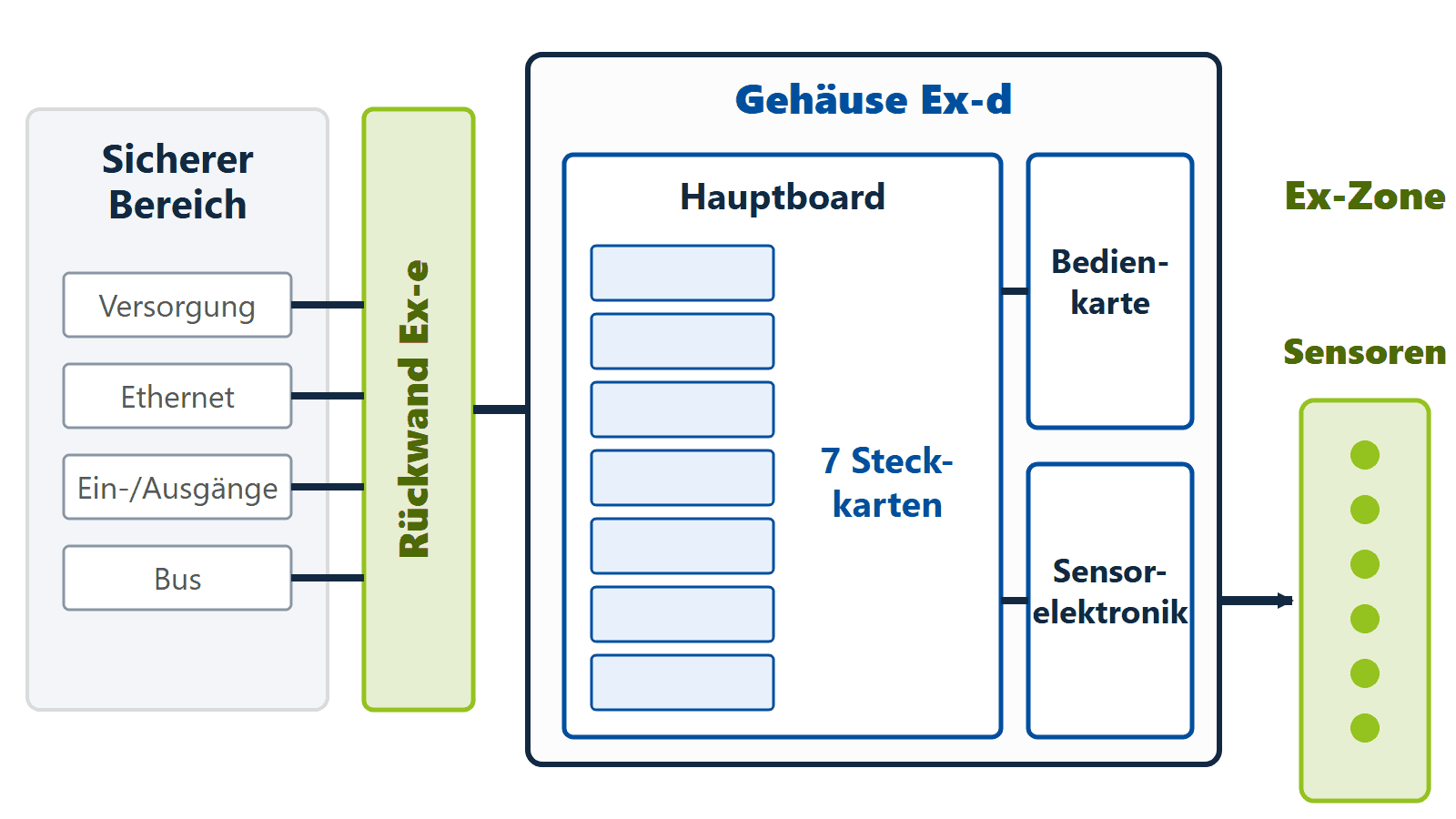
The electronics were split across ten circuit boards: a main board with a processor module, a backplane in increased safety for the external connections, plug-in interface cards, plus sensor electronics and an operating board. Each card identifies itself through an address chip with slot and type, so the firmware recognises the configuration without anyone setting jumpers. What has to be intrinsically safe sits on its own cards with its own design; what stays inside the flameproof enclosure does not have to be intrinsically safe, but remains subject to the requirements on the device as a whole.
The development process was geared to approval. Schematic and layout of every board went to the client and to the certification body for review, and the boards were developed in a fixed order so that the intrinsically safe parts could be reviewed first. For every board there was a commissioning plan before the first power-up, released by the client.
We delivered the design and production documents for all boards, the design of the intrinsically safe circuit parts as input to the client's approval file, the commissioning records and the system test plan, and organised qualification with the laboratories.