
IIoT & Energy
A charging station that charges torque tools without charging contacts
Concept, hardware and configuration of a contactless Qi charging station for torque tools, from proof-of-concept to EMC pre-testing.
The task
A battery-powered torque tool is put down between two jobs, and that holder is the natural place to charge it. Charging contacts on the housing are the usual solution, but in a workshop the contacts are also where dirt and wear set in. Contactless charging removes that weak spot: put the tool down and it charges.
The client wanted its own Qi charging station to match its tool family. A tool is not a smartphone on a charging mat: it sits on the coil with metal parts and a housing shape of its own. The station may only transfer power when a matching receiver is in place, and it must limit power or shut down when metallic foreign objects are present.
The solution
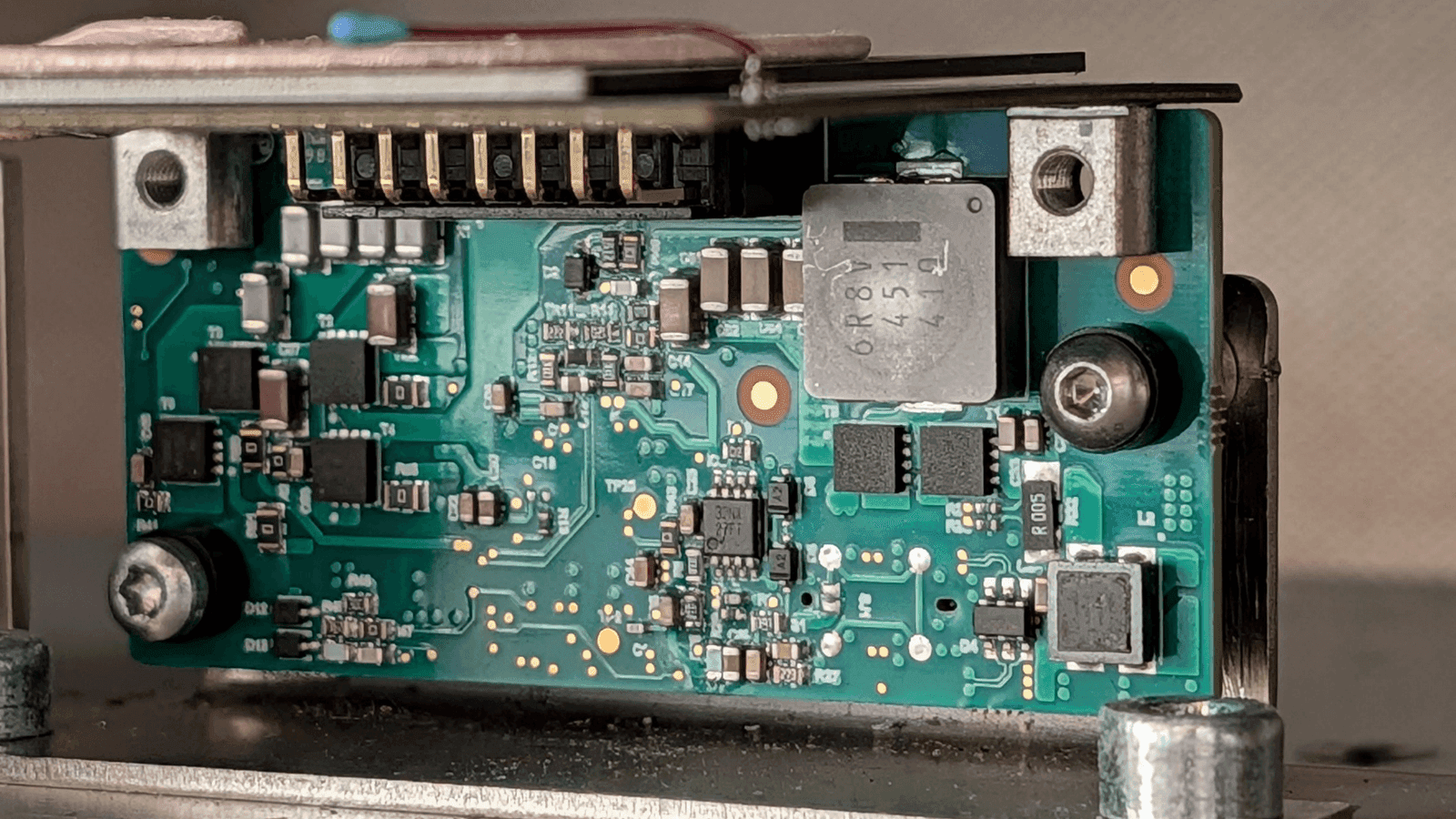
The charging station is split across two circuit boards. The transmitter board carries the Qi transmitter IC, the inverter, the voltage regulation and the coil current measurement. The coil board carries the transmitter coil and the indicator lights and can be positioned freely to suit the housing. Power comes in over USB; the cable shield is connected to the station's reference potential.
We started with a proof-of-concept on evaluation hardware to check whether the required coupling and power could be reached with the tool at all. Requirements and concept followed, then schematics and layout of both boards through to bring-up. We set up the configuration of the transmitter IC, in particular foreign object detection and tuning to the coil, in several iterations on the real mechanical setup and tested it with established metallic test objects.
EMC pre-testing took place early, on the first hardware, so that changes to the coil and layout could still go into the second round instead of only coming to light at the test lab during regulatory approval. The deliverables are the concept, the schematics and layouts of both boards, the tuned configuration of the charging IC, and the results of bring-up and pre-testing.